Forty-seven transactions sit on a client’s monthly bank statement. Thirty-nine are familiar: the same SaaS subscriptions, the same payroll runs, the same rent payment that has hit on the third of every month for two years. Eight do not fit neatly. One is a new vendor. One has a truncated description that could mean almost anything. One is three times larger than the client’s usual spend with that merchant. Another could be an owner draw or a legitimate business expense, depending on context nobody has provided yet.
So the question lands on your desk: which of those eight actually need a reviewer’s time? Send all eight and you clog the queue with noise. Send none and you make assumptions that could distort the financials. The challenge is not spotting transactions that look different, because every bookkeeper can do that. The challenge is deciding which differences are meaningful enough to warrant human attention, and which can be processed confidently with the information already on hand.
A weak process fails in two opposite directions. Under-flagging lets important transactions pass through without the review they needed. Over-flagging buries the reviewer in so many items that the ones that matter get lost. This article lays out a framework for telling the difference, moving from routine transactions to review candidates to client clarification to professional judgment, so the right work reaches a person and the rest keeps moving.
A bank transaction should be flagged for review when the available data, client-specific rules, transaction context, supporting documentation, or accounting treatment is not enough to process it confidently. A flag is a request for a second look, not a verdict that something is wrong. A good bank transaction review surfaces the right items while letting genuinely routine transactions move through.
Flagging is about confidence, not suspicion. Flag a transaction when you cannot process it confidently with the data, rules, and context you have, and let everything else through.
- A flag means “this needs another look,” not “this is wrong.” Unusual does not equal incorrect, and high-value does not equal risky.
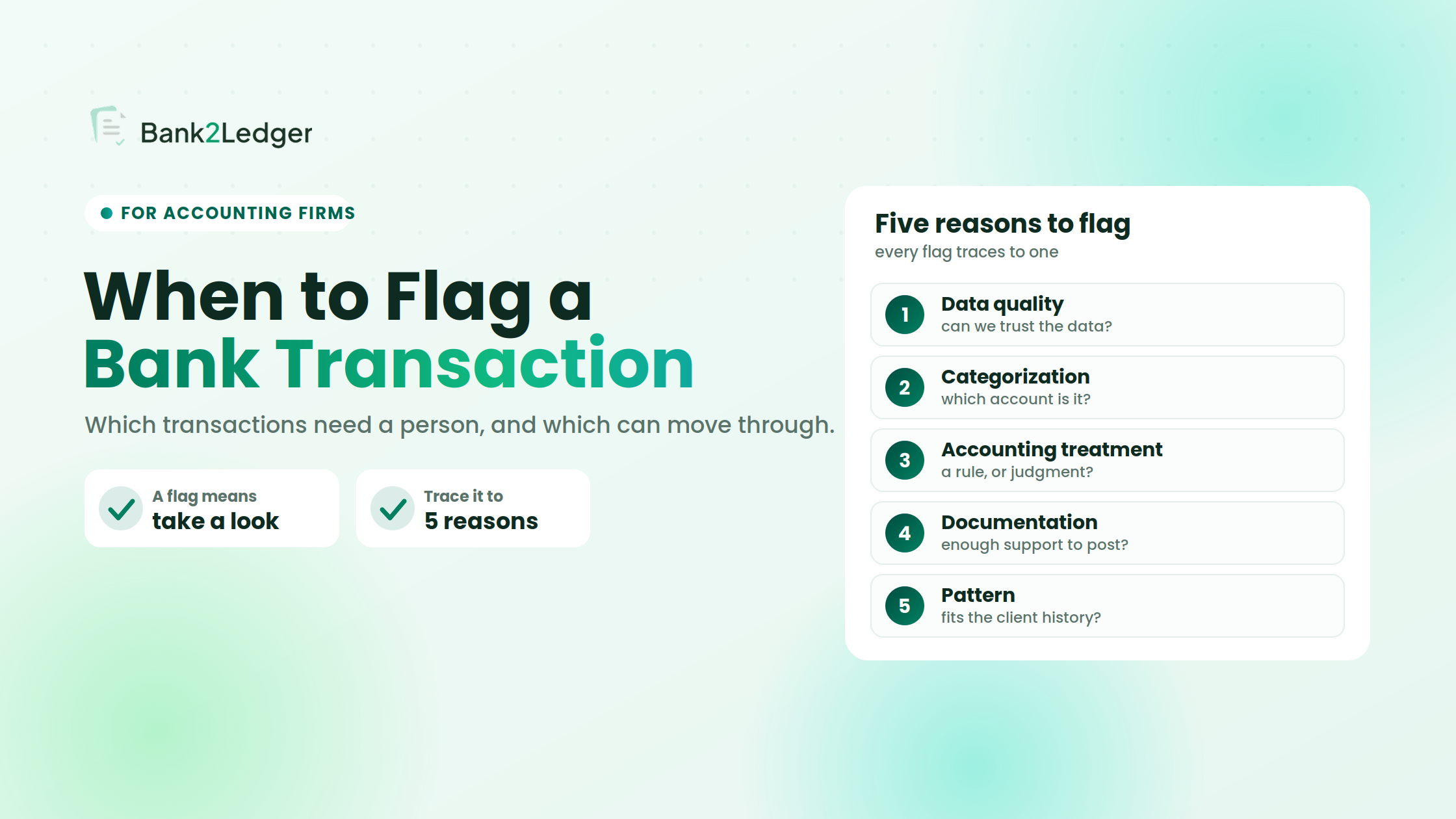
- Every flag should trace to one of five uncertainties: data quality, categorization, accounting treatment, documentation, or pattern.
- Use a short decision sequence, not a gut feeling about whether a transaction looks strange.
- Over-flagging has a real cost: alert fatigue, a noisy queue, and reviewers who stop trusting it. What a system leaves alone matters as much as what it catches.
What does it mean to flag a bank transaction for review?
A bank transaction is flagged for review when the available transaction data, established client rules, supporting information, and normal accounting workflow are not enough to process it confidently without additional investigation or judgment. That is the working definition, and it is deliberately about confidence rather than correctness.
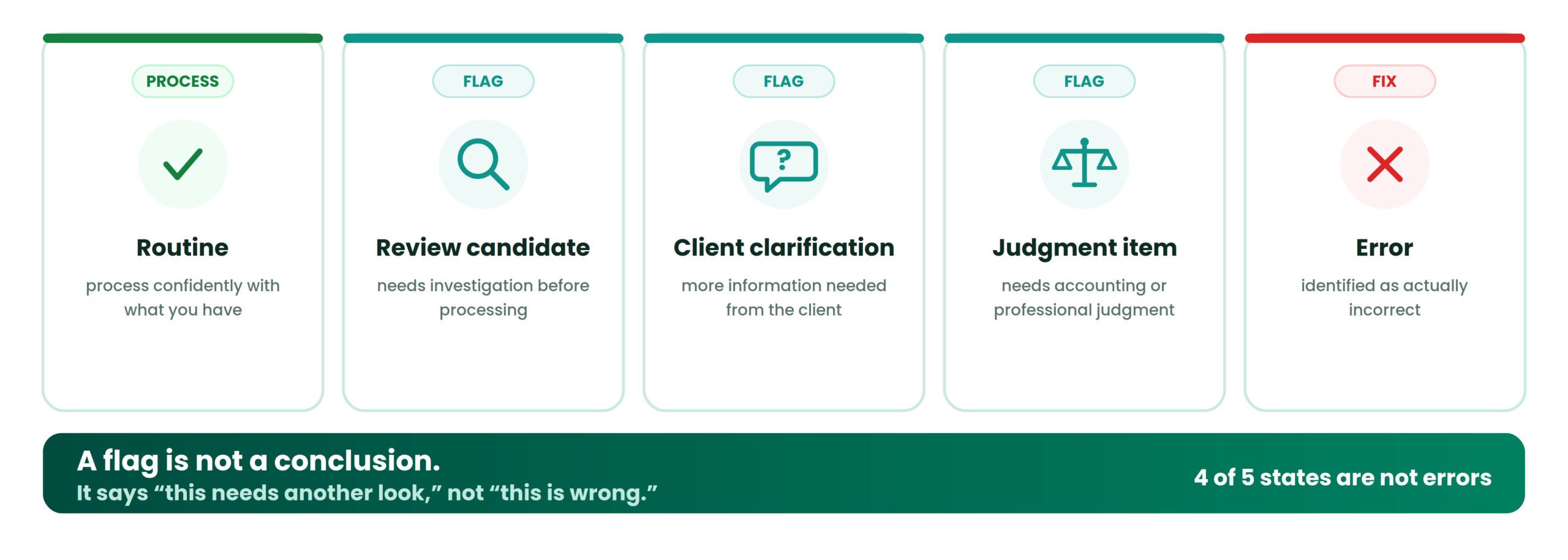
It helps to name the states a transaction can be in, because they are not the same thing and should not be treated as one.
| Term | Meaning |
|---|---|
| Routine transaction | Can be processed confidently using established information and rules |
| Review candidate | Requires additional investigation or attention before processing |
| Client clarification | More information is needed from the client |
| Judgment item | Requires accounting or professional judgment |
| Error | Something has been identified as actually incorrect |
The distinction that matters most: a flag is not a conclusion. It means “this transaction needs another look.” It does not mean “this transaction is wrong.” Teams that treat every flag as an accusation develop a defensive relationship with their queue, and that slows everything down.
So the goal of a review system is not to maximize flags. It is to surface the right transactions while allowing genuinely routine ones to move through efficiently.
Not every unusual transaction needs a review
Unusual does not automatically mean incorrect. A client normally pays a software vendor $300 a month. One month the charge is $1,500. That is unusual, but it is not evidence of a mistake.
The $1,500 could be an annual renewal, additional licenses, an implementation fee, two months billed together after a cycle change, or a one-time add-on. Without more context you cannot know. So the rule is unusual amount leads to investigate, not unusual amount leads to assume error. A lot of review processes break down right here, conflating “I have not seen this before” with “something is wrong.”
| Situation | Initial response |
|---|---|
| Known recurring transaction | Usually routine |
| New vendor | Investigate context |
| Unusually large amount | Investigate |
| Known annual payment | May still be routine |
| Ambiguous description | Review |
| Established transfer between client accounts | Usually routine |
| Unknown transfer | Review |
| Known vendor with new accounting treatment | Review |
The takeaway is that the system needs context, not just anomaly detection. An amount that looks strange in isolation can be completely routine once the client’s history explains it.
The five reasons a bank transaction may need review
A transaction can require review for different reasons, and those reasons should not be treated as interchangeable. Fixing a data problem is not the same as resolving an accounting-treatment question. Every flag should trace back to one of these five categories of uncertainty, and if a transaction triggers none of them, it probably does not need a reviewer.
1. Data-quality uncertainty
Key question
Can we trust the transaction data itself?
Before any accounting question, the first filter is whether what was extracted from the statement is reliable. The warning signs are a missing transaction, a duplicate-looking line, an unclear date, an unreadable amount, an incorrect debit or credit direction, an incomplete statement, a missing page, an inconsistent running balance, or a malformed description.
These are data problems, not necessarily accounting problems, but questionable source data creates downstream errors that are far harder to find later. If a statement shows an opening balance of $10,000, transactions of $4,000, and a closing balance of $14,800, something does not reconcile, and the right response is not to guess the missing transaction. This is why extraction accuracy alone is not enough, and why a statement can balance and still be missing transactions when errors offset each other. Only once the underlying data is sufficiently reliable should the workflow move on to categorization.
2. Categorization uncertainty
Key question
Do we know which account this transaction belongs to?
Assume the data is clean. The next question is whether the transaction can be assigned to the right account. Categorization gets uncertain with an unfamiliar merchant, a new vendor, a vague description, no matching client rule, multiple plausible accounts, or inconsistent historical categorization where the same vendor was coded two different ways in prior months.
“AMZN Mktp US $840” is the classic case. The merchant name alone does not tell you whether it is office supplies, equipment, inventory, software, or another business purchase. Merchant recognition is not accounting categorization. Client-specific context is what resolves it, which is exactly why categorization rules need to be client-specific rather than based on a generic merchant database. When that context does not exist yet, the transaction earns a flag.
3. Accounting-treatment uncertainty
Key question
Can this be processed with a routine rule, or does its accounting treatment require judgment?
Some transactions are correctly extracted, correctly identified, and correctly matched to a payee, and still require professional judgment. A potential capital expenditure, an owner contribution, an owner draw, loan proceeds, a loan repayment, an unusual transfer, a related-party transaction, a tax payment, or a large asset purchase can all be perfectly legitimate and still not be clear enough to process routinely.
A $15,000 payment to an equipment supplier is a good example. The issue is not whether the payment is wrong. It is whether the accounting treatment is clear enough to process without judgment, since that $15,000 might need capitalizing rather than expensing. No rule engine resolves this, because the answer depends on the client’s circumstances, the nature of the transaction, and sometimes a conversation with the client. This is where the line between bookkeeping and accounting judgment lives, and it is a reminder that automation cannot settle every accounting decision.
4. Documentation uncertainty
Key question
Do we have enough supporting information to process or review this confidently?
Sometimes the transaction looks normal but the evidence is incomplete: a missing receipt, a missing invoice, an unclear business purpose, a missing agreement, or an insufficient client explanation. The question is whether the transaction can be supported adequately for the firm’s workflow.
The nuance here is that not every transaction requires a receipt. Documentation expectations depend on the firm’s workflow, the transaction type, the engagement requirements, and any applicable rules. A $4,500 payment to a new contractor may be entirely legitimate, but if the description is vague and no supporting documentation is available, that may warrant a client question before final categorization.
5. Pattern or anomaly uncertainty
Key question
Does the transaction materially differ from the client’s established pattern?
Individual transactions can be measured against the client’s own history: an unusual amount, an unusual frequency, an unexpected vendor, unexpected timing, a new transaction type, a sudden change in a recurring expense, or an unusual transfer. The point is not fraud detection. An anomaly is a reason to investigate, not proof of an error or wrongdoing.
A company normally pays $700 to $900 a month for a service. This month it is $6,800. The explanations could include an annual renewal, multiple invoices, expansion, a one-time implementation, a duplicate payment, or a genuine error. The flag tells the reviewer “this needs context,” not “this is wrong.” External review guidance treats unusual activity as a signal too: the Washington State Auditor’s Office names it in its guidance on reviewing bank statements, though primarily in a fraud-prevention context. In a bookkeeping workflow the purpose is broader, surfacing transactions where the available context does not yet explain the deviation.
A practical transaction-review decision tree
Instead of asking whether a transaction looks strange, work through a short sequence of practical questions. Any transaction that is not immediately obvious can be run through these five checks in order.
| Review question | If yes | If no |
|---|---|---|
| Is the data complete? | Continue | Flag |
| Is there an established rule? | Continue | Investigate context |
| Does it fit the client’s pattern? | Continue | Investigate |
| Does it require judgment? | Process only if resolved | Flag |
| Is required support available? | Process | Clarify or flag |
This is a practical workflow framework, not a universal accounting standard. Firms should adapt it to client risk, engagement requirements, internal controls, materiality, accounting policies, and any applicable professional requirements.
Surface the right transactions before they hit the ledger
Bank2Ledger extracts bank-statement transactions, verifies the numbers reconcile, applies your client-specific rules, and holds lower-confidence lines for review inside the pre-accounting workflow. The decision tree works best when the routine transactions are already handled for you.
Five transaction examples: routine vs. review
The same logic, applied to concrete cases. Note the hedged wording: whether any one of these is actually routine depends on the client’s rules and history, so treat the table as illustrative rather than a set of universal treatments.
| Transaction | Likely treatment | Reason |
|---|---|---|
| Monthly $89 SaaS charge with an established rule | Routine | Known recurring transaction |
| New $2,800 vendor payment | Review | New vendor, context needed, no rule |
| Regular rent payment | Routine | Established pattern |
| $12,000 equipment purchase | Review | Possible accounting-treatment question |
| Known transfer between client accounts | Usually routine | Established transaction type |
| Unknown large transfer | Review | Purpose and context unclear |
| Annual insurance payment | Potentially routine | Historical pattern explains the variation |
| New merchant with a vague description | Review | Categorization uncertainty |
Context changes everything. The same $2,800 vendor payment might be routine for a client who buys from that vendor monthly under an established rule. That is why the table leans on words like likely, usually, potentially, and may rather than stating a treatment as fixed.
What should not automatically trigger a review?
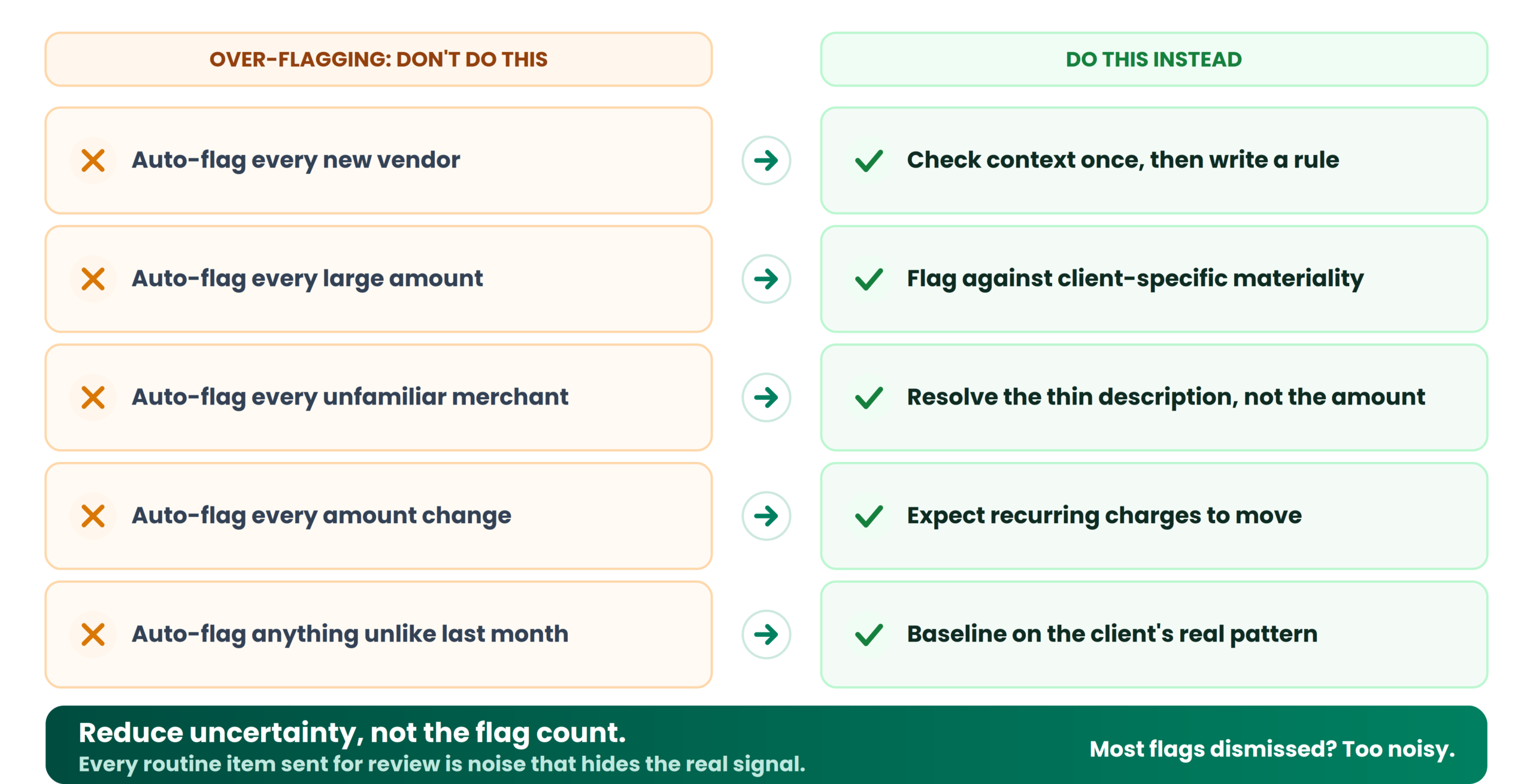
Over-flagging is its own failure mode. A few things, on their own, are not good automatic triggers.
Every new vendor
New vendors happen constantly as businesses change suppliers and add services. A new vendor can be a reason to check context, but it is not automatically an error or even unusual.
Every large transaction
Large is contextual. A $5,000 payment is routine for one client and extraordinary for another. A dollar threshold with no client-specific materiality behind it will flag the wrong things.
Every unfamiliar merchant
Bank descriptions are truncated and cryptic, and the same vendor can appear under several payment processors. Unfamiliar does not mean incorrect; it usually just means the description is thin.
Every amount change
Recurring payments legitimately move. Usage-based charges, price increases, and annual true-ups all change the amount without changing the meaning of the transaction.
Every transaction that differs from last month
Businesses are not static. Expecting this month to match last month exactly guarantees a queue full of normal change.
A good review system should reduce uncertainty, not maximize the number of flags. Think of it as signal-to-noise: every routine transaction sent for review is noise that makes the real signal harder to see. If reviewers dismiss most of what reaches them as routine, the queue is too noisy and the criteria need tightening.
The cost of over-flagging
When everything gets flagged, the problem compounds down a predictable path.
Alert fatigue
This creates a second, quieter problem. When everything is presented as requiring attention, genuinely important items become harder to distinguish from routine ones. Reviewers adapt by skimming, dismissing in bulk, or trusting the queue less, and the exact transactions the system exists to catch are the ones that slip past.
The quality of a review system depends not only on what it catches, but also on what it correctly leaves alone. If every transaction becomes an exception, the exception queue stops being useful.
How client-specific rules change what gets flagged
The same transaction can be routine for one client and a review item for another. Consider an Adobe payment.
Client A: Adobe maps to Software Expense under an established rule. Routine. It processes automatically.
Client B: Adobe could be software, marketing, or a shared corporate charge depending on which department initiated it. It needs context before posting.
So the identical charge is routine for Client A and review-worthy for Client B. Transaction-review logic cannot be separated from client context, which means it needs the client’s Chart of Accounts, historical treatment, established rules, known vendors, and transaction patterns to work.
Firms that try to build one universal set of flagging rules across all clients end up over-flagging for simple clients and under-flagging for complex ones. This is why automating categorization with rules and a Chart of Accounts works best when it is configured per client rather than from a generic database.
What a good review queue should contain
“Please review this transaction” is not enough. A flag that arrives without context forces the reviewer to start the investigation from scratch, which is most of the time cost. A useful review item carries what the reviewer needs to decide quickly.
| Information | Purpose |
|---|---|
| Date | Identify the transaction |
| Amount | Understand the value at stake |
| Payee or description | Identify the transaction |
| Reason for the flag | Explain why attention is needed |
| Suggested category | Give the reviewer a starting point |
| Client rule or context | Explain the expected treatment |
| Supporting evidence | Reduce investigation time |
| Missing information | Define what is still needed |
| Next action | Make the resolution clear |
| Owner | Establish responsibility |
The difference in practice is stark. Bad: “Please review $4,850 transaction.” Better: “New vendor, no matching client rule. Description suggests an annual software subscription. Prior treatment unavailable. Confirm the category before posting.” The second version lets the reviewer decide in about thirty seconds.
Where Bank2Ledger fits into the transaction-review process
A transaction-review framework is only useful if the bookkeeping workflow can identify and surface the right transactions before they disappear into the accounting system. That work happens upstream, in the preparation and validation layer.
The right framing is that Bank2Ledger helps move transaction preparation and validation upstream, as part of the pre-accounting process. It is not the reviewer, and it does not determine the correct accounting treatment for every transaction. It prepares and validates the data, and surfaces what needs attention, before the work reaches a person.
A bank transaction review checklist
A reusable checklist keeps the framework practical. Run a flagged or uncertain transaction through these groups, then set its final status.
Data quality
Categorization
Accounting treatment
Documentation
Pattern review
Final status
How firms should improve their flagging rules over time
Every reviewed exception produces information. A workflow that captures it gets quieter over time; one that does not re-discovers the same uncertainty every month.
False-positive flag. A transaction is flagged, reviewed, and found routine. Create or update a client rule so it processes automatically next time.
Repeated client question. The same type of transaction keeps needing client clarification. Improve the client intake or documentation requirements so the context arrives up front.
Genuine judgment item. A transaction consistently needs senior review. Keep it as an escalation category rather than trying to rule it away.
The message is simple: a mature bookkeeping workflow should learn from review decisions rather than repeatedly rediscovering the same uncertainty.
Common mistakes when designing transaction review rules
Flagging everything unusual
Treating every deviation as a flag creates noise that buries the real exceptions. Unusual is a prompt to check context, not an automatic trigger.
Using only dollar thresholds
Amount alone lacks context. A $5,000 transaction is routine for one client and extraordinary for another, so a flat threshold flags the wrong things in both directions.
Ignoring client history
Client context changes what a transaction means. Reviewing every client through the same generic lens discards the single most useful input you have.
Treating flags as errors
Flags are investigation prompts, not accusations. When a team treats them as errors, the review queue becomes something to defend against rather than work through.
Giving reviewers no context
A reviewer should understand why something was flagged. Without the reason, the suggested category, and what is missing, every item becomes a fresh investigation.
Never updating the rules
Repeated exceptions should improve the workflow. Firms that never update their rules review the same predictable transactions month after month.
Automating before defining the criteria
Technology should implement a clear workflow. It cannot substitute for defining what “needs review” actually means, and automating an undefined process just produces faster confusion.
Frequently asked questions
What is a bank transaction review?
A bank transaction review is the process of examining extracted bank-statement transactions to confirm each one has correct data, appropriate categorization, adequate documentation, and consistent accounting treatment before it enters the general ledger. The review identifies items that need investigation or professional judgment rather than routine processing.
Which bank transactions should be flagged for review?
Transactions where one of five uncertainties applies: data quality is in doubt, categorization is ambiguous, accounting treatment requires judgment, documentation is missing, or the transaction deviates materially from the client’s established pattern. A transaction that triggers none of these can usually be processed routinely.
Does an unusual bank transaction always need review?
No. Unusual means it deviates from the expected pattern, and that deviation often has a straightforward explanation, like an annual renewal on a normally monthly subscription. The real question is whether the available evidence and rules are sufficient to process it confidently.
Should every new vendor transaction be reviewed?
No. New vendors happen all the time as businesses change suppliers. A new vendor can be a reason to check context, especially when no client rule exists yet, but it is not automatically an error or something wrong.
Should large bank transactions always be reviewed?
No. Amount is one possible signal, not a universal rule. A large transaction is only meaningful against client-specific materiality: a figure that is routine for one client may be extraordinary for another, so a flat dollar threshold flags the wrong things.
What makes a transaction difficult to categorize?
Usually an ambiguous or truncated description, a new or unfamiliar vendor, the absence of a matching client rule, inconsistent historical treatment, or a transaction that could plausibly belong to several accounts. Merchant recognition alone rarely resolves the correct accounting category.
How can accounting firms reduce unnecessary transaction flags?
Build client-specific categorization rules, use historical patterns as baselines, define clear flagging criteria tied to the five uncertainty categories, and update the rules based on resolved exceptions. Most unnecessary flags come from missing context, not from genuinely ambiguous transactions.
Can automation determine which transactions need review?
Automation can apply defined rules, check patterns, verify that balances reconcile, and surface low-confidence items. It cannot make accounting judgments, confirm business purpose, or settle the treatment of owner transactions, capital expenditures, or related-party activity. Firms still need appropriate human review controls.
Good review sends the right transactions to people, not more of them
Good transaction review is not about sending more transactions to people. It is about sending the right transactions to people, and giving the reviewer exactly the context they need to resolve them quickly. The whole model is a short sequence.
Bank2Ledger addresses the upstream part of this process by extracting bank-statement transactions, verifying the extracted data, applying client-specific Chart of Accounts rules, and surfacing the lower-confidence items for review before the data moves into the accounting workflow. Define your flagging criteria first, then let the preparation layer do the repetitive part, so your reviewers spend their time on the transactions that genuinely need a person. The next bottleneck most firms hit after this is reviewer capacity, which is worth tackling as its own workflow problem.
Put the right transactions in front of your reviewers
Bank2Ledger prepares and validates bank-statement data upstream: extraction, balance verification, client-specific categorization, and exception review built into the pre-accounting process. Give your team a queue worth trusting.