A bookkeeper marks a client’s monthly work complete and moves it to the review queue. The senior accountant opens the file. Inside: one missing bank statement, a handful of uncategorized transactions, a reconciliation difference nobody investigated, inconsistent treatment of a recurring vendor, and three questions that should have been asked two weeks ago.
The file goes back. The bookkeeper fixes some of it, asks the client about the rest, waits, then resubmits. The reviewer opens it again. Two issues remain. Back it goes.
That reviewer just touched the same file three times. Multiply that across twenty or forty clients and the review queue isn’t a queue anymore. It’s a bottleneck.
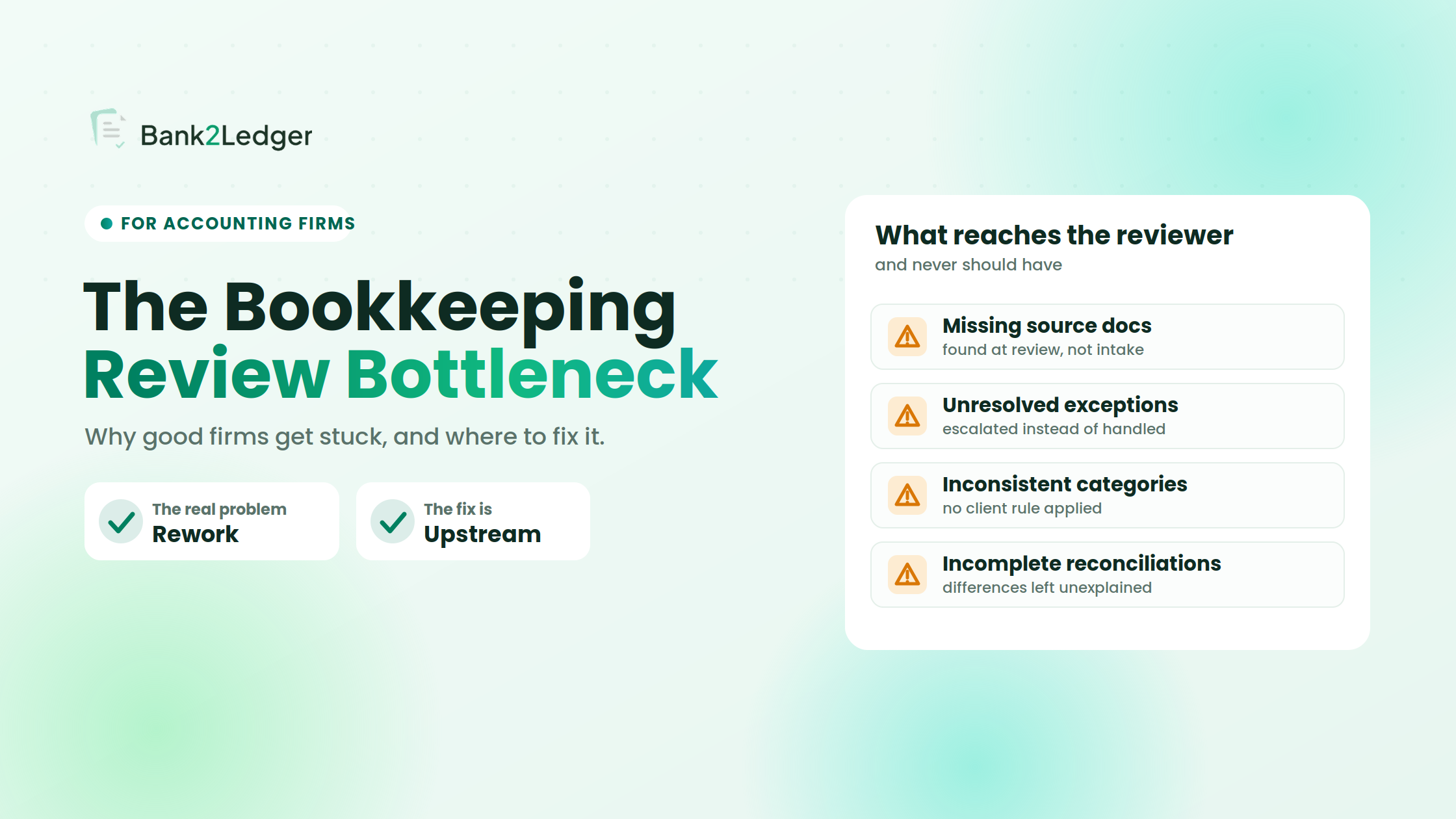
The visible problem is a growing stack of files waiting for senior sign-off. The underlying problem is how much avoidable work is entering that stack. Bookkeeping review becomes a bottleneck when too much of what reaches the reviewer should have been caught, resolved, or documented during preparation. Missing source documents, unresolved exceptions, inconsistent categorization, and incomplete reconciliations all consume reviewer capacity on cleanup instead of judgment.
This article breaks down why that happens, what “review-ready” should actually mean inside a firm, and where the upstream workflow needs to change so that review time is spent on work that genuinely requires it.
A bookkeeping review bottleneck happens when completed files pile up in the review queue faster than a reviewer can meaningfully assess them, usually because avoidable preparation problems, missing documents, unresolved exceptions, inconsistent categorization, keep reaching the reviewer. The fix is upstream: define what review-ready means, add a preparer self-review, and resolve routine exceptions before they hit the queue.
The review bottleneck is usually an upstream preparation problem disguised as a reviewer-capacity problem. Reviewers get stuck doing cleanup that should have happened during preparation, so define review-ready, catch issues earlier, and reserve senior time for genuine judgment.
- A bottleneck forms when files loop (prepare, review, return, fix) instead of moving (prepare, review, approve).
- Most lost time comes from reviewers doing preparation work: hunting documents, recategorizing, chasing reconciliations.
- A written Review-Ready Standard with six components is the single biggest operational improvement most firms can make.
- Track rework, not just review time, and fix recurring problems at the source rather than every month.
What is a bookkeeping review bottleneck?
A bookkeeping review bottleneck occurs when completed work accumulates faster than it can be meaningfully reviewed and released. Files sit. Deadlines drift. The reviewer becomes the constraint.
In a functioning workflow, the path is simple: prepare, review, approve. In a bottlenecked workflow, it loops: prepare, review, return, fix, review, return, fix, review. Each cycle burns reviewer time and preparer time on the same client. The work isn’t moving forward. It’s orbiting.
The goal is not to skip review. Review catches judgment errors, risk issues, and inconsistencies that only experienced eyes will find. The goal is to stop reviewers from spending that time on problems that never should have reached them: a missing statement, an unexplained variance, a transaction coded to the wrong account for the third month running.
Reviewer capacity is finite. When a firm has one or two senior people clearing every file, every minute spent on avoidable cleanup is a minute unavailable for the review work that actually protects the firm and its clients.
Why good accounting firms still develop review bottlenecks
1Too much work depends on one reviewer
A common firm structure puts three or four preparers feeding work to a single senior accountant. That works at low volume. As client count grows, the math breaks: more preparers means more files in the queue, but reviewer capacity stays flat. Hiring another bookkeeper can actually make the bottleneck worse if the review layer doesn’t scale with it. Concentrated review authority isn’t inherently bad. It becomes a constraint when the volume of files requiring sign-off exceeds what one person can clear in the available window.
2Reviewers are doing preparation work
This is where firms lose the most time without realizing it. A reviewer opens a file expecting to assess quality and apply judgment. Instead, they’re hunting for a missing credit card statement, re-categorizing transactions the preparer left uncoded, investigating a reconciliation difference, and reformatting workpapers. When reviewers spend significant time preparing the file, review becomes a second preparation stage. The firm is paying senior rates for junior-level tasks.
3“Ready for review” has never been defined
A preparer thinks “done” means “I finished entering the transactions.” A reviewer thinks “done” means reconciliations complete, exceptions flagged, documentation attached, unusual items explained, and a self-review performed. Without a shared, written definition of review-ready, every preparer ships work at a different standard. Some files arrive clean. Others arrive half-finished. The reviewer can’t tell which is which until they open it. That discovery process is itself a time cost, and it is one reason inconsistent categorization creates downstream problems that compound at review.
4Exceptions are not being handled upstream
An unknown merchant. An unusual amount. A transaction that looks like a duplicate but might be a legitimate repeat charge. A transfer between accounts that hasn’t been matched. Not every one of these needs senior judgment. Many can be investigated and resolved by the preparer using existing client rules, prior-month history, or a quick look at supporting documents. The question worth asking about each exception: does this require reviewer judgment, or could it have been investigated earlier?
5Rework is not being measured
Firms track client count, hours, deadlines, utilization. Few track how many files get returned from review, why they get returned, or which errors repeat month after month. Without that data, the firm sees the symptom (a backed-up review queue) but can’t diagnose the cause.
The hidden cost of bookkeeping rework
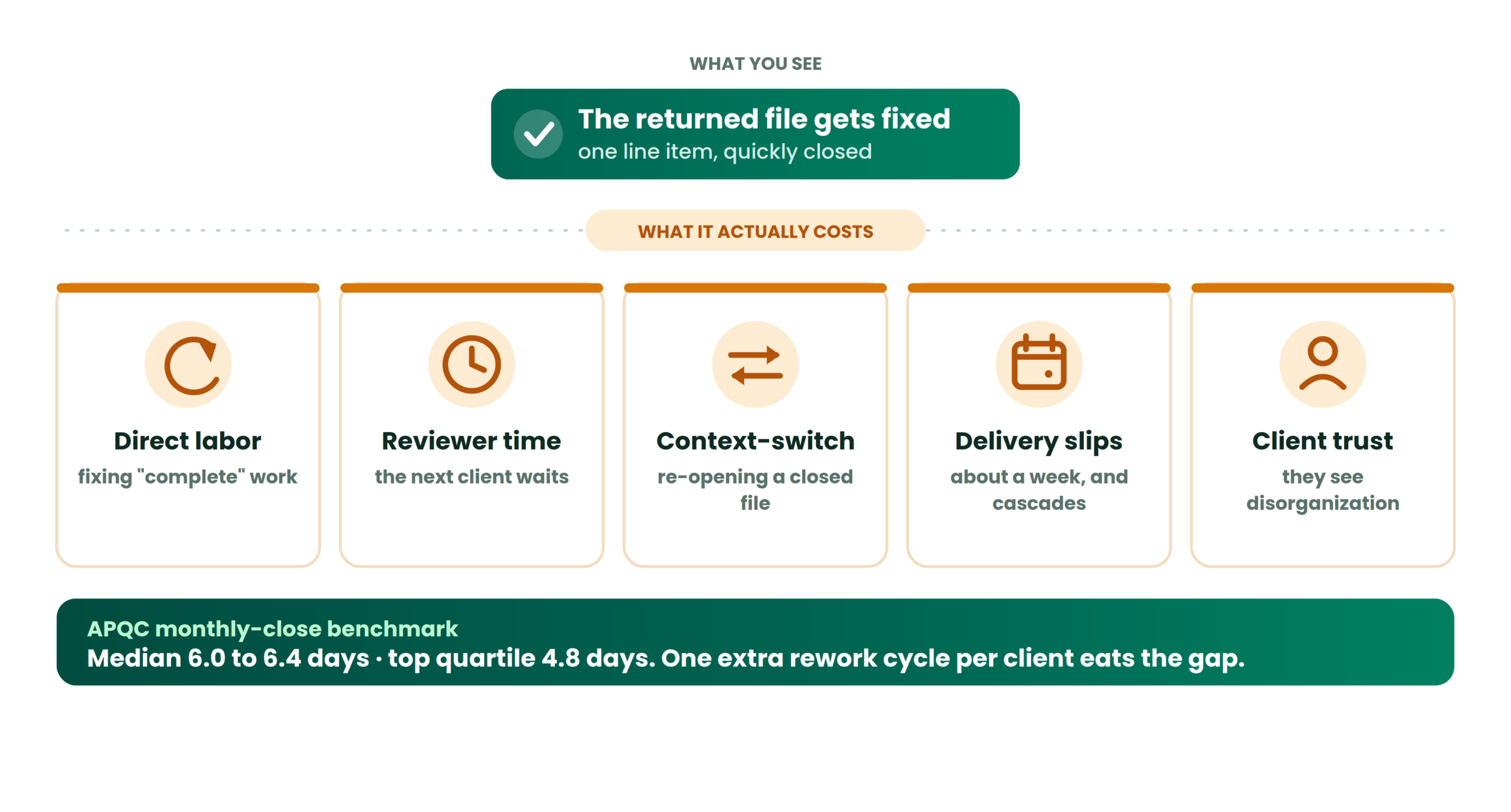
Rework is not just an error problem. It is a capacity problem.
Someone has to fix the issue, which means direct labor on work that was supposedly complete. The reviewer loses time they would otherwise spend on the next client. The preparer has to context-switch back into a file they mentally closed days ago, re-reading notes and re-opening bank feeds to remember where things stood.
Delivery timelines slip. If a file bounces between preparer and reviewer twice, the client’s monthly bookkeeping might be delivered a week late. That delay can cascade into tax preparation, management reporting, and advisory work that depends on clean books.
Client communication suffers too. A missing document that should have been requested during intake now triggers an awkward mid-cycle email. The client sees disorganization. The firm absorbs the follow-up time.
APQC benchmark data puts median monthly close at 6.0 to 6.4 calendar days, with top-quartile organizations closer to 4.8 days or fewer. When avoidable rework adds even one extra review cycle per client, that window tightens fast.
What should “ready for review” mean?
This is where firms can make the single biggest operational improvement. Define a Review-Ready Standard with six components.
Source completeness. Required statements received, correct period confirmed, missing information documented before the file moves forward. The reviewer should not be the first person to discover that a required bank statement is missing. Firms that struggle with this step often benefit from a structured intake process that catches gaps before processing begins.
Processing completeness. Transactions processed, transfers handled, categorization reviewed against client-specific rules. No bulk of uncoded transactions sitting in an “ask my accountant” category.
Reconciliation status. Applicable accounts reconciled, differences investigated, unusual balances identified, unresolved items documented with context. A reconciliation difference with no explanation is just a task the reviewer now has to do.
Exception handling. Unusual transactions identified. Routine exceptions resolved using existing rules or client history. Judgment items documented clearly, with the specific question stated. “Needs review” tells the reviewer nothing. “Merchant appears to be software expense based on prior three months, but no client rule exists” tells them everything.
Documentation. Relevant support attached, significant judgments noted, explanations recorded where a transaction’s treatment might not be obvious.
Preparer self-review. The preparer reviewed their own work before submitting. Obvious errors addressed. The file meets the firm’s written review-ready definition.
A file can be ready for review without being completely free of judgment calls. Review-ready means the reviewer receives a sufficiently prepared file where the remaining work genuinely requires review rather than basic cleanup.
The 3 layers of review efficiency
The higher the quality of Layers 1 and 2, the more valuable Layer 3 becomes. When the first two layers are weak, Layer 3 collapses into a second round of preparation. The reviewer isn’t reviewing. They’re rebuilding.
Why reviewers end up doing work that should have happened earlier
| Problem reaching review | What should have happened earlier |
|---|---|
| Missing bank statement | Source-data check at intake |
| Uncategorized transaction | Processing review by preparer |
| Unknown transaction | Exception investigation |
| Reconciliation difference | Reconciliation review before submission |
| Inconsistent category | Client-rule check |
| Missing support | Documentation check |
| Formatting issue | Preparer self-review |
Every one of these items could have been resolved upstream. Every one that wasn’t consumed reviewer capacity on work that isn’t really review.
Key question
What is my reviewer fixing today that my process should have prevented yesterday?
How to reduce bookkeeping review rework
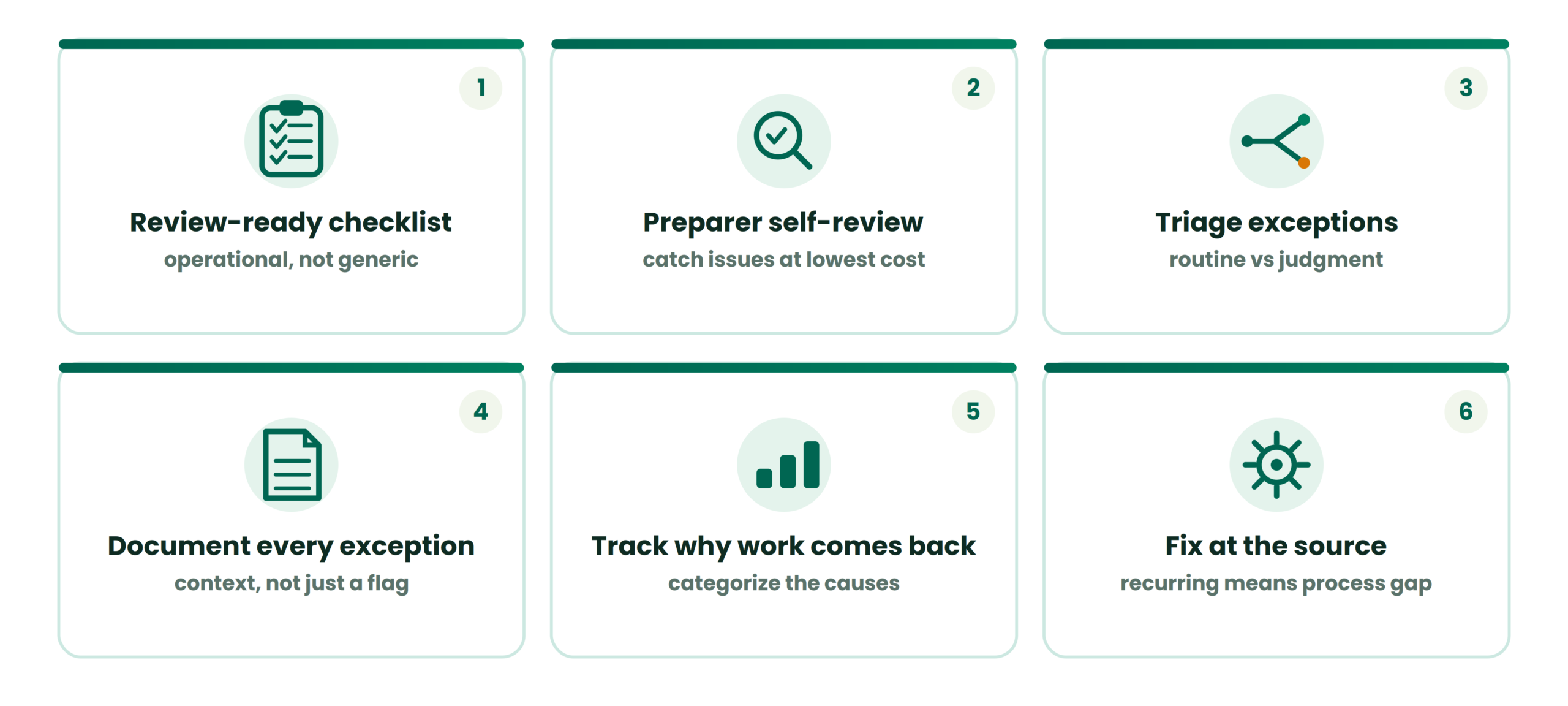
Define a review-ready checklist. Not a generic one. An operational one. “Bank account reconciled, unresolved differences documented, uncategorized transactions reviewed, support attached, preparer self-review completed” is useful. “Review the bookkeeping” is not.
Add a preparer self-review. Before the senior reviewer sees the file, the preparer performs a structured self-check against the firm’s review-ready definition. This catches basic issues at the lowest-cost point in the workflow.
Separate routine exceptions from judgment items. A routine exception can be resolved using existing rules, client history, documentation, or known transaction patterns. A judgment item requires senior review, client clarification, or accounting judgment. When everything gets escalated equally, the reviewer becomes a triage desk.
Document the reason for every exception. Context is what makes reviewer time efficient. Extraction accuracy alone doesn’t solve the problem if the preparer cannot explain why a transaction was flagged.
Track why work comes back. Build categories: missing information, categorization, reconciliation, documentation, client clarification, processing error, reviewer judgment. Without this data, you’re guessing at the cause.
Fix repeated problems at the source. If the same issue comes back every month, it is probably no longer a review problem. It is a process problem. Maybe it needs a client-specific rule, a checklist update, staff training, or a workflow change.
Fix the review bottleneck where it starts: the source data
Bank2Ledger prepares bank-statement transaction data before it reaches your accounting system, with extraction, verification, client-specific categorization rules, and exception review built in, so fewer avoidable issues ever reach the reviewer.
How accounting firms can measure their review bottleneck
Track these internally. Don’t look for industry benchmarks here; this is about your firm’s own trajectory.
Review queue size: how many files are waiting?
Review wait time: how long does a completed file sit before someone opens it?
Review cycle time: how long does the review itself take?
Rework rate: how often are files returned?
Rework reasons: what causes returns?
Repeat issues: which problems show up month after month?
And one metric worth creating if you don’t have it: first-pass acceptance rate. That’s the percentage of files that meet the firm’s review-ready standard without being returned for avoidable corrections. It’s not an industry number. It’s your number.
What the review queue can tell you about the workflow
| What you see | What it may indicate |
|---|---|
| Large queue, short reviews | Reviewer capacity or availability constraint |
| Small queue, long reviews | Complex or poorly prepared files |
| Many returned files | Weak preparation or unclear standards |
| Same issue repeatedly | Missing rule, process gap, or training need |
| Reviewer fixing basic issues | Poor review readiness |
| Frequent client questions during review | Weak source-data intake |
These aren’t universal rules. But patterns in your queue can point to the upstream stage where the real friction lives.
Common mistakes that make review bottlenecks worse
Sending everything to the reviewer. Not every uncertainty requires senior escalation. Some questions have answers in last month’s file.
Having no written definition of “ready for review.” Without a shared standard, every preparer has a different threshold for complete. The reviewer absorbs the variance.
Fixing the same error every month instead of updating the process. A recurring miscategorization is a missing rule, not a review finding.
Measuring review time but not rework. A reviewer who clears files quickly can still be overloaded if those files keep coming back.
Adding preparers without addressing the constraint. More preparers feeding into the same reviewer capacity just grows the queue. APQC data shows that top-quartile organizations close in 4.8 days or fewer, and that gap isn’t explained by headcount alone.
Automating before standardizing. Automation applied to a poorly defined process accelerates the mess. Standardize first, then identify which parts benefit from automation. Understanding what pre-accounting actually means helps clarify where automation fits and where it doesn’t.
Where practitioners disagree
There’s a live debate about whether preparers should resolve exceptions themselves or simply flag them for the reviewer with context. One camp argues that letting preparers make categorization decisions on ambiguous transactions introduces risk, especially with junior staff. The other camp argues that forcing every exception to the reviewer is exactly what creates the bottleneck, and that building client-specific rules gives preparers a framework to resolve routine items safely. I land on the second side, because the alternative means the reviewer is functionally doing the preparation, but I recognize this depends heavily on the experience level of the team and the firm’s risk tolerance. It’s not settled.
Review-ready bookkeeping checklist
Source
Processing
Reconciliation
Exceptions
Documentation
Review readiness
Frequently asked questions
What is a bookkeeping review bottleneck?
A bookkeeping review bottleneck occurs when completed bookkeeping files accumulate in the review queue faster than the reviewer can meaningfully assess and release them. It typically results from avoidable preparation issues reaching the reviewer, creating multiple review cycles per file and consuming senior capacity on work that should have been resolved upstream.
Why does bookkeeping work get stuck in review?
Common causes include missing source documents, unresolved exceptions, inconsistent categorization, incomplete reconciliations, and concentrated review authority where one person clears all files. When “ready for review” hasn’t been defined as a firm standard, preparers and reviewers operate on different assumptions about what complete means.
How can accounting firms reduce bookkeeping review time?
Improve preparation quality before files reach review. Define a review-ready standard, add a preparer self-review step, separate routine exceptions from judgment items, and track rework reasons so recurring problems get fixed at the source.
What does “review-ready” mean in bookkeeping?
It means the file has passed six checks: source completeness, processing completeness, reconciliation status, exception handling, documentation, and preparer self-review. The reviewer receives a file where remaining work genuinely requires senior judgment.
What causes bookkeeping rework?
Source-data gaps, processing errors, unresolved reconciliation differences, missing documentation, inconsistent categorization, and unclear communication between preparer and reviewer.
Should every bookkeeping file be reviewed by a senior accountant?
That depends on the firm’s policies, engagement type, risk profile, staff experience, and applicable professional requirements. Not every engagement carries the same review obligations, and CPA.com distinguishes between preparation, compilation, and review workflows for good reason.
Can automation reduce bookkeeping review work?
It can reduce certain repetitive preparation and validation tasks, but automation does not eliminate the need for appropriate review and professional judgment. Where it helps most is upstream: improving data quality before it enters the accounting workflow so that fewer avoidable issues reach the reviewer.
The path forward
The bookkeeping review bottleneck is, in most firms, an upstream preparation problem wearing the disguise of a reviewer-capacity problem. Better source data leads to more consistent processing, which leads to cleaner exception handling, which produces review-ready files, which means fewer review cycles and more valuable use of senior time.
The frameworks here (the Review-Ready Standard, the three layers, the queue diagnostics) aren’t theoretical. They’re the operational questions that surface when you stop asking “why is my reviewer slow?” and start asking “what is reaching my reviewer that shouldn’t be?”
Start with the layer that feeds everything else
Bank2Ledger prepares bank-statement transaction data before it reaches the accounting system, with extraction, verification, client-specific categorization rules, and exception review built into the pre-accounting process. If your bottleneck starts with source-data quality, that is the layer to look at first.