A new bookkeeping client sends over a zip file. Inside: twelve months of bank statements, a QuickBooks login on a sticky note, and a one-line email that says “here’s everything.” The firm opens the accounting file and finds unreconciled accounts going back two years, a Chart of Accounts with 300+ line items (half of them duplicates), and no clear record of which bank accounts are even active.
That client technically “provided everything.” The firm still can’t start.
This is the core problem with bookkeeping client onboarding as most firms practice it. The process gets treated as document collection. Get the engagement letter signed, get the bank logins, get the prior-year financials, check the boxes. But collecting items and being ready to begin recurring bookkeeping are two different states. One is administrative. The other is operational.
By the end of this piece, you’ll have a framework for determining whether a new client is actually ready for their first bookkeeping cycle, not just whether they’ve submitted their paperwork.
The short version
A bookkeeping client is onboarded when the firm has the scope, access, account inventory, historical starting point, accounting rules, and responsibilities needed to process the first period, not when the client has simply uploaded files. Collecting documents is intake. Turning them into a workable engagement is onboarding.
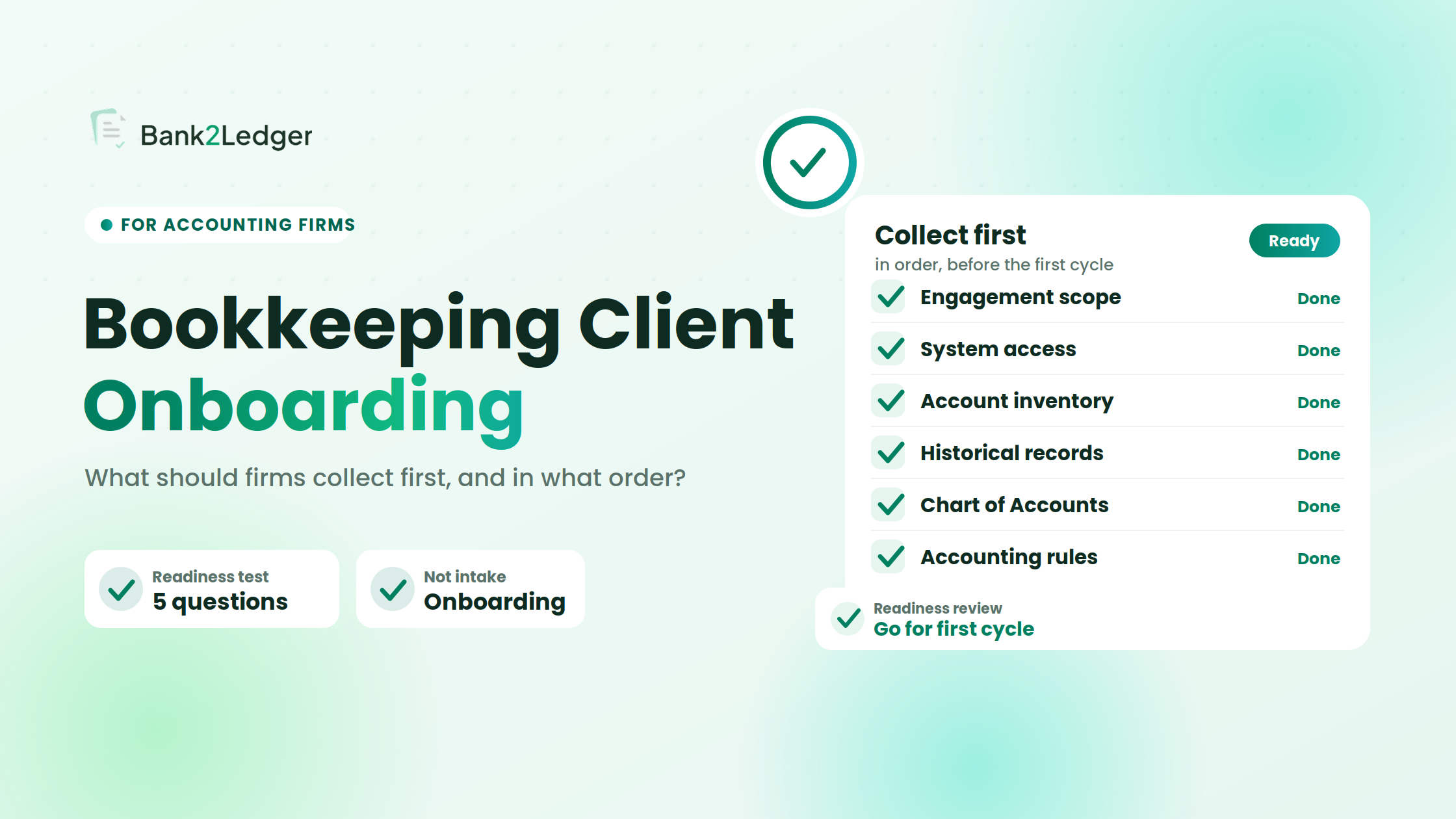
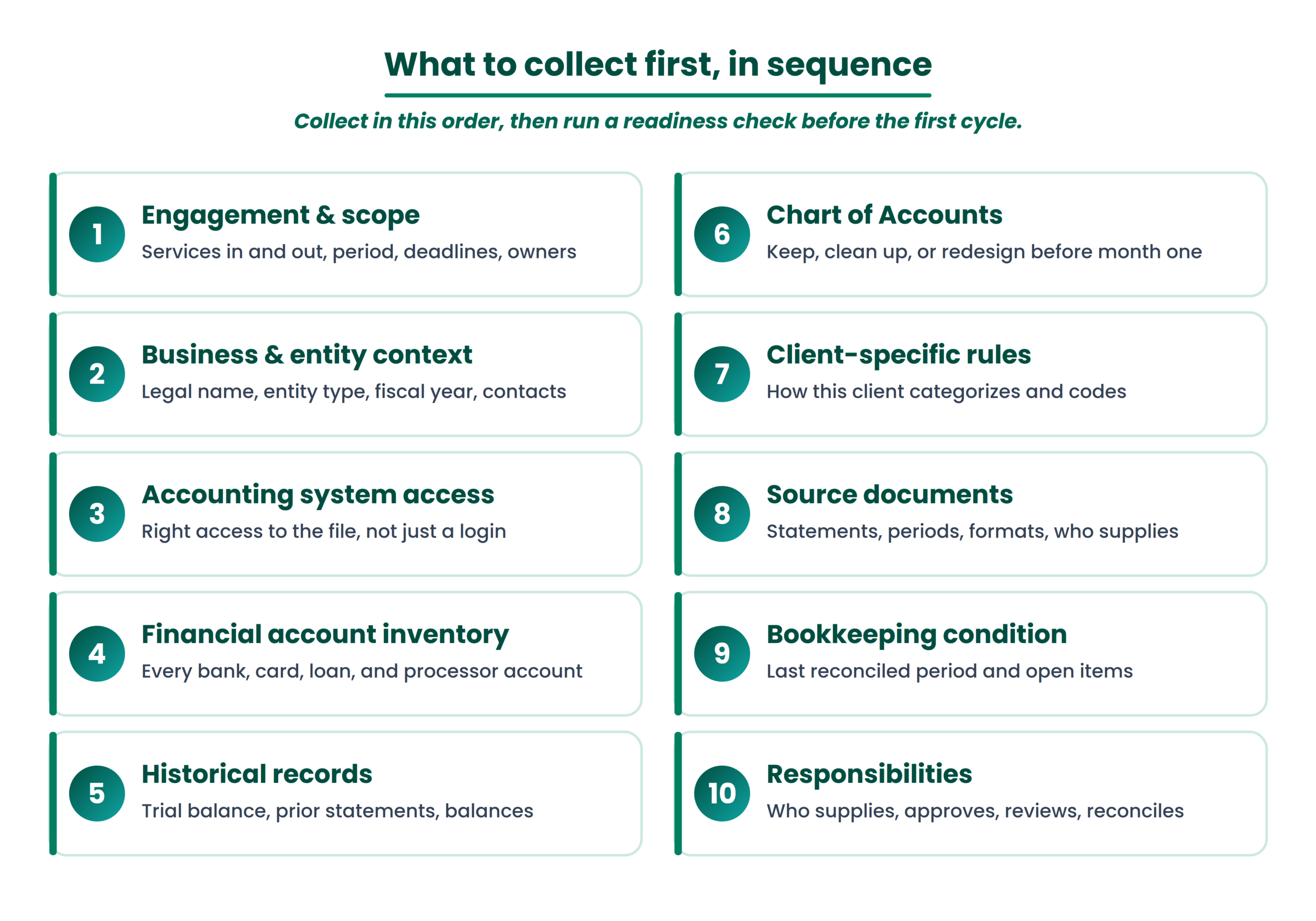
- Collect in sequence: scope, client context, system access, account inventory, historical records, Chart of Accounts, accounting rules, responsibilities.
- Build an account inventory, not just a pile of bank statements. You cannot reconcile an account you do not know exists.
- Request system access first, then request the records you can only verify once access is live.
- Finish with a readiness review: a go/no-go decision before the first bookkeeping cycle.
Who this is for (and who should stop here)
This applies to firms taking over bookkeeping for a client who already has some financial history: existing bank accounts, a prior accounting file, maybe a predecessor accountant. If you’re setting up a brand-new entity with no transaction history, the onboarding problem is simpler and most of this won’t apply.
This article covers the thinking underneath the checklist, the part that determines whether ticking every box actually means you’re ready.
What bookkeeping client onboarding actually establishes
Bookkeeping client onboarding is the structured process of moving a newly engaged client from a signed scope of work to a state where the firm has the information, access, records, responsibilities, and accounting context needed to begin the engagement.
That definition matters because it draws a line. Onboarding isn’t finished when the client uploads files. It’s finished when the firm can answer these questions without guessing:
If any of those remain open, the engagement isn’t onboarded. It’s in intake.
Intake collects information. Onboarding turns that information into a workable engagement. You can complete one without completing the other.
What a bookkeeping firm should collect first
A bookkeeping firm should first establish the engagement scope, client and entity information, accounting-system access, a financial-account inventory, historical accounting records, Chart of Accounts structure, client-specific accounting rules, responsibilities, and the information required to begin the first bookkeeping period. That’s the short answer. Here’s how each category works and why it matters in sequence.
Engagement and scope
Collect the signed engagement agreement, but also confirm what it actually covers: services included, services excluded, the bookkeeping period, reporting frequency, expected close deadlines, and who is responsible for what.
Without scope clarity, onboarding quietly expands. Historical cleanup becomes assumed. Payroll gets folded in. AR/AP management shows up on the firm’s plate because nobody documented that it wasn’t included. Chaser’s onboarding resources flag this as the consistent starting point across current guides, and for good reason. Scope confusion is the single fastest way to turn a profitable client into an unprofitable one.
Business and entity context
The firm needs to understand the client’s structure before touching the books. Legal business name, entity type, fiscal year, reporting requirements, ownership details where relevant, and contacts (primary plus backup).
This isn’t just administrative. Entity type affects how owner transactions are recorded. Fiscal year determines reporting periods. A multi-location business may have accounts the client forgets to mention.
Accounting software and system access
This section trips up more firms than it should. The question isn’t “do we have a login?” It’s “do we have the right access to perform the agreed work?”
Check which platform the client uses (QuickBooks, Xero, Sage, Zoho Books, or sometimes just spreadsheets). Determine whether the firm is taking over an existing file or starting fresh. Confirm who currently has administrator access. Verify whether bank feeds are connected and whether relevant integrations (payroll platforms, payment processors, POS systems, ecommerce tools) are active.
A firm that requests access before understanding the existing setup often spends the first week figuring out what the previous accountant built, rather than doing bookkeeping. That’s a week of unbillable discovery disguised as onboarding. If you’re evaluating what to automate first in your bookkeeping workflow, system access is the dependency that unlocks everything else.
Financial account inventory
This is where most checklist-based onboarding falls short. Firms ask for bank statements. They should be building an account inventory.
| Account type | What to collect |
|---|---|
| Bank accounts | Institution, account number, currency, active/closed status |
| Credit cards | Account details, statement source |
| Loans | Lender, current balance, statements |
| Payment processors | Platform, settlement account, payout records |
| Merchant accounts | Processor details, deposit mapping |
| Other financial accounts | Relevant statements and records |
You cannot reconcile an account the firm doesn’t know exists. A client might have a savings account used for quarterly tax payments, a PayPal account receiving occasional customer payments, or a line of credit that shows up as transfers in the operating account. If those aren’t in the inventory, the first reconciliation will surface them as unexplained variances.
This concept is showing up in newer onboarding frameworks. ClientFileFlow’s account and system inventory approach, for example, treats the inventory as a prerequisite rather than a byproduct of statement collection.
Historical financial records
The firm needs enough historical data to establish the starting point. Depending on the engagement, this may include the latest trial balance, prior financial statements, general ledger data, previous reconciliations, relevant tax returns, and opening-balance documentation.
Not every client needs every document. The required records depend on the engagement period, the condition of the existing books, and whether the firm is picking up mid-year or at a fiscal year boundary. A clean handoff from a predecessor accountant looks completely different from taking over a file that hasn’t been reconciled in eighteen months. For a detailed breakdown of what to verify when bank statements arrive, the bank statement intake checklist for accounting firms covers the operational layer.
Chart of Accounts and accounting structure
Review the existing Chart of Accounts before processing a single transaction. Check account naming conventions, account types, tracking categories or classes, and whether the structure actually reflects how the business operates.
The critical question: is the firm using the client’s existing structure, cleaning it up, or redesigning it? That decision needs to happen during onboarding, not after three months of posting to a bloated CoA with duplicate accounts. Merging or archiving accounts after the fact can break historical reporting. Current community guidance consistently recommends standardizing the CoA before the first live month.
Client-specific accounting rules
A new client doesn’t just bring data. They bring accounting context. How are recurring expenses categorized? How are inter-account transfers treated? How are owner draws or contributions handled? Which vendors have established categories? Are there recurring journal entries?
This is where generic onboarding breaks down most visibly. Two clients in the same industry, using the same accounting software, can have completely different categorization conventions. Applying a one-size-fits-all approach produces a clean-looking ledger that the client doesn’t recognize. For a deeper look at why this matters, the piece on why bank transaction categorization rules need to be client-specific covers the mechanics.
Source document and statement requirements
Establish which statements are required, which periods they cover, accepted file formats, where files should be uploaded, and who supplies them. Also define what happens when a document is missing.
One distinction worth making explicit: onboarding document collection is a one-time activity. Recurring monthly document collection is an ongoing workflow. They overlap, but they aren’t the same process, and conflating them creates confusion about what’s “done” and what’s “ongoing.”
Existing bookkeeping condition
Before promising a clean monthly close, assess what already exists. Check the last reconciled period, unreconciled accounts, outstanding items, unknown balances, and missing records.
This assessment often reveals that the engagement is actually two jobs. Job one: historical cleanup or catch-up. Job two: recurring bookkeeping. Combining them without separate scoping is how firms end up doing months of unbilled cleanup work embedded inside what was quoted as a monthly bookkeeping fee.
Responsibilities and communication
Define who supplies documents, who answers questions, who approves decisions, who confirms unusual transactions. On the firm side, define who processes, reviews, reconciles, and reports. Then establish the communication channel, response expectations, and monthly deadline.
Without ownership assignments, missing information sits in limbo. Nobody chases it because nobody owns it.
How to tell if a new bookkeeping client is actually ready
Here’s a five-question readiness test. If the answer to any of these is “no,” onboarding isn’t complete, regardless of how many documents are in the folder.
That last question is the one that separates intake from readiness. A firm can have a signed engagement letter, accounting software access, and a stack of bank statements, and still be unable to start because the prior trial balance doesn’t agree with the opening balance sheet, or because two bank accounts weren’t disclosed, or because nobody knows how the client handles owner transactions.
The problems that surface after “complete” onboarding
| Problem | Root cause | What actually fixes it |
|---|---|---|
| First close doesn’t tie out | Opening balances don’t match the prior trial balance | Rebuild the starting balance sheet from the prior file before posting new transactions |
| Bank feed looks complete but cash is off | Merchant deposits and payout timing aren’t mapped | Reconcile feeds against payment processor reports and payout batches |
| Chart of Accounts bloats immediately | Client history imported without standardizing categories | Merge duplicates and archive unused accounts before the first live month |
| Uncategorized transactions pile up monthly | No categorization rules set during onboarding | Build rules and recurring task templates during setup, not after |
| Client says “I sent everything” but work is blocked | Firm asked for documents before verifying system access | Request access first, then request records that can only be verified once access is live |
Where practitioners disagree
There’s an active debate about ordering: should firms request system access before documents, or collect documents first and then set up access? One side argues that access lets you verify what the client sends against what’s actually in the file, catching gaps immediately. The other side argues that collecting documents first gives the firm context before they start navigating an unfamiliar accounting system. I land on access first, because you can’t verify a trial balance or identify missing accounts without seeing the existing file, and documents without context just create a folder of unvalidated PDFs.
Where bank statement processing fits
During onboarding, the firm establishes which accounts exist, which statements are required, and which periods need coverage. Once those statements arrive, the next challenge is turning raw statement data into accounting-ready transactions. That’s the pre-accounting step between bank statements and the general ledger.
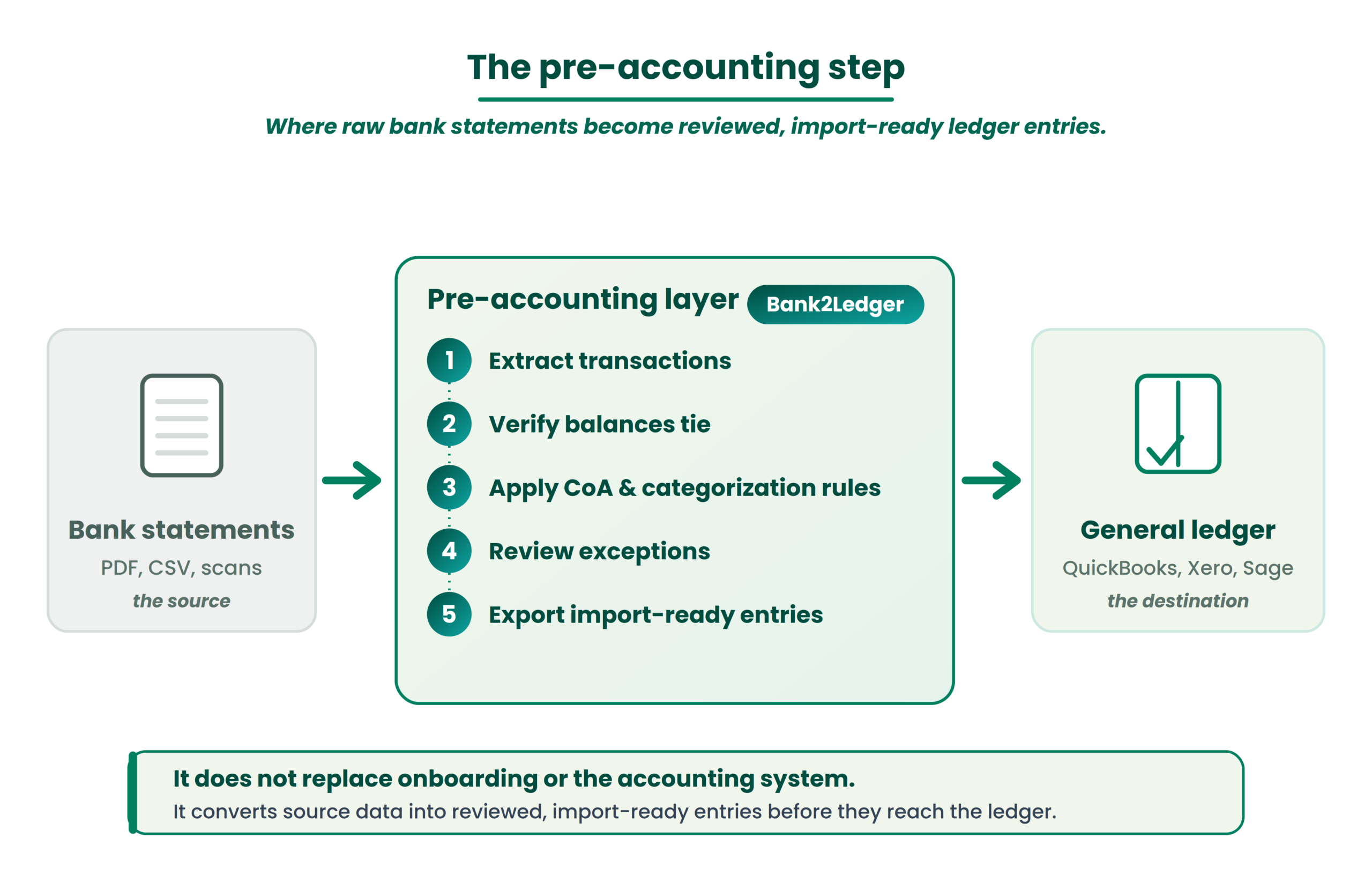
Bank2Ledger sits in that pre-accounting layer: upload the statement, extract transactions, verify balances, apply the client’s Chart of Accounts and categorization rules, review exceptions, and export. It doesn’t replace onboarding or the accounting system. It handles the operational step of converting source data into reviewed, import-ready ledger entries before they reach QuickBooks, Xero, or whatever platform the client uses.
Process onboarding statements without the surprises
Upload a client’s statements, extract and verify every transaction against the balances, apply their Chart of Accounts and categorization rules, and export import-ready entries. See how Bank2Ledger handles the pre-accounting step.
Making onboarding repeatable
The firms that onboard consistently follow a sequence, not a checklist. The checklist is a tool inside the sequence.
Each step has a defined output. The intake form produces entity details. The account inventory produces a verified list of financial accounts. The readiness review produces a go/no-go decision. If you skip the readiness review, you’re starting work on faith.
Frequently asked questions
What should a bookkeeping firm collect from a new client?
A bookkeeping firm should collect engagement scope documentation, business and entity details, accounting-system access, a complete financial-account inventory, historical records sufficient to establish opening balances, Chart of Accounts structure, client-specific categorization rules, defined responsibilities, and confirmation that the first bookkeeping period can be processed without critical gaps.
What is the difference between client intake and client onboarding?
Intake is collecting information. Onboarding is turning that information into a workable engagement. A firm can complete intake (all documents received, all forms filled out) and still not be onboarded if the books aren’t assessed, access isn’t verified, or the first-period scope isn’t confirmed.
When is a bookkeeping client fully onboarded?
When the firm can answer yes to all five readiness questions: scope is clear, all accounts and systems are identified, historical starting points are established, accounting rules and responsibilities are documented, and the team can begin the first period without waiting for missing information.
Should historical cleanup be included in recurring bookkeeping?
Identify and scope it separately. Cleanup has a defined start and end. Recurring bookkeeping is ongoing. Bundling them obscures the true cost of each and usually means the firm absorbs cleanup hours at the recurring rate.
Collect the right information, in the right order
Good bookkeeping client onboarding isn’t about collecting the most documents. It’s about collecting the right information in the right order and knowing, before the first transaction is posted, that the firm has enough context to begin. Scope, then client context, then systems, then accounts, then historical data, then accounting rules, then responsibilities, then readiness. Skip the readiness check and you’ll find out what’s missing the hard way: mid-close, with a deadline approaching and a client who thought everything was already handled.
Start every engagement on reviewed, import-ready data
Bank2Ledger turns a new client’s statements into verified, categorized, import-ready ledger entries before the first close. Convert, validate, and export on your client’s Chart of Accounts.