Yes. A bank statement can balance even when transactions are missing. A normal tie-out checks whether the net transaction movement agrees with the opening and closing balances. If two missing or incorrect transactions offset each other, the overall balance can still match even though individual transaction data is incomplete.
That’s the short answer, and it surprises people who assume a matching closing balance means the extracted data is complete.
A tie-out can detect missing transactions when their omission changes the net movement, but it cannot by itself rule out every possible combination of offsetting errors. That single sentence is the entire reason this article exists. By the end, you’ll understand what a statement tie-out actually proves, where its blind spots sit, and what additional controls close those gaps.
Who this applies to
If you’re an accountant, bookkeeper, or outsourced finance professional processing bank statement PDFs for client books, this matters to you. Particularly if you’re converting statements from PDF into structured data and relying on a balance check as your primary quality gate.
If you’re a consumer reconciling a personal checking account, this level of detail probably isn’t necessary. Your bank’s online portal and a quick scroll will get you there.
Yes, a bank statement can balance even when transactions are missing
A tie-out checks net movement
The math is simple:
Or equivalently: closing balance − opening balance = net transaction movement.
If the extracted transactions produce the same net movement as the original statement, the tie-out passes. It’s an aggregate check. It tests the total, not the individual rows.
Two opposite errors can cancel each other
Here’s an illustrative example.
| Item | Amount |
|---|---|
| Opening balance | $10,000 |
| Transaction A | −$1,000 |
| Transaction B | +$500 |
| Transaction C | −$300 |
| Transaction D | +$800 |
| Closing balance | $10,000 |
Net movement: −$1,000 + $500 − $300 + $800 = $0. The statement ties.
Now suppose the extracted dataset misses a −$500 debit and a +$500 credit. The combined effect of those two omissions is zero. The closing balance still agrees with the opening balance plus the remaining transactions. The tie-out passes. Two transactions are gone.
Why this is an edge case, not the normal outcome
A single missing transaction almost always breaks the tie-out. That’s the whole point of the control. It works.
The vulnerability appears only when multiple errors offset. A missing $200 debit paired with a missing $200 credit. Or a transaction extracted $150 too high alongside another extracted $150 too low. These combinations are uncommon, but they’re not impossible, especially when PDF extraction encounters page breaks, multi-line descriptions, or layout shifts that can affect more than one row at a time.
The risk isn’t that tie-outs are weak. They’re strong. The risk is treating a passing tie-out as proof of completeness when it’s actually proof of mathematical consistency.
What a bank statement tie-out actually proves
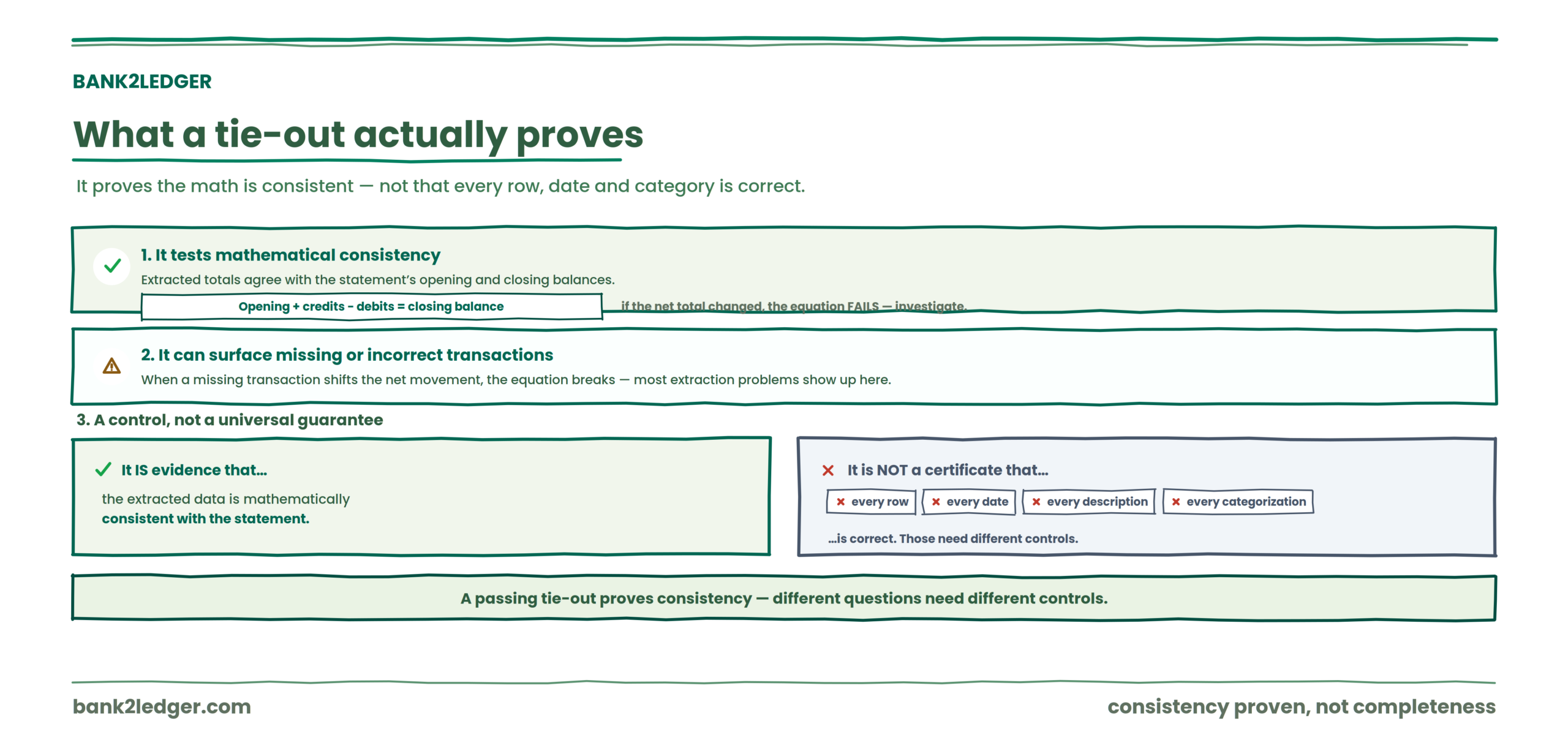
It tests mathematical consistency
The extracted transaction totals agree with the statement’s opening and closing balances. That’s a meaningful signal. If something went wrong during extraction and it changed the net total, the equation fails and you know to investigate.
It can surface missing or incorrect transactions
When a missing transaction shifts the net movement, the equation breaks. Most extraction problems show up here. That’s why every serious bank statement processing workflow includes this check.
It provides a control, not a universal guarantee
A successful tie-out is evidence that the extracted data is mathematically consistent with the statement. It is not a certificate that every row, every date, every description, and every categorization decision is correct. Those are different questions requiring different controls.
What a successful tie-out does not prove
It does not prove every description is correct
A merchant name could be garbled during extraction while the dollar amount stays intact. The tie-out won’t notice. The balance doesn’t care what the transaction is called.
It does not prove every date is correct
A transaction dated January 15 instead of January 5 has zero effect on the aggregate total. The tie-out passes. The date is still wrong.
It does not prove categorization is correct
A $500 payment can be perfectly extracted, perfectly included in the balance, and mapped to the wrong expense account. That’s a categorization problem, not a mathematical one.
It does not replace accounting review
Some transactions require context. A large round-number transfer might be an intercompany movement or a client refund. The numbers can be right while the accounting treatment remains undecided.
It does not establish document authenticity
Mathematical consistency doesn’t prove the source PDF is genuine. That’s a separate verification question entirely, and one that competitors like DocuClipper are now addressing through metadata and document-fingerprint checks. Important work, but outside the scope of a balance tie-out.
How missing transactions can hide inside a balanced statement
Missing transactions that change the net balance
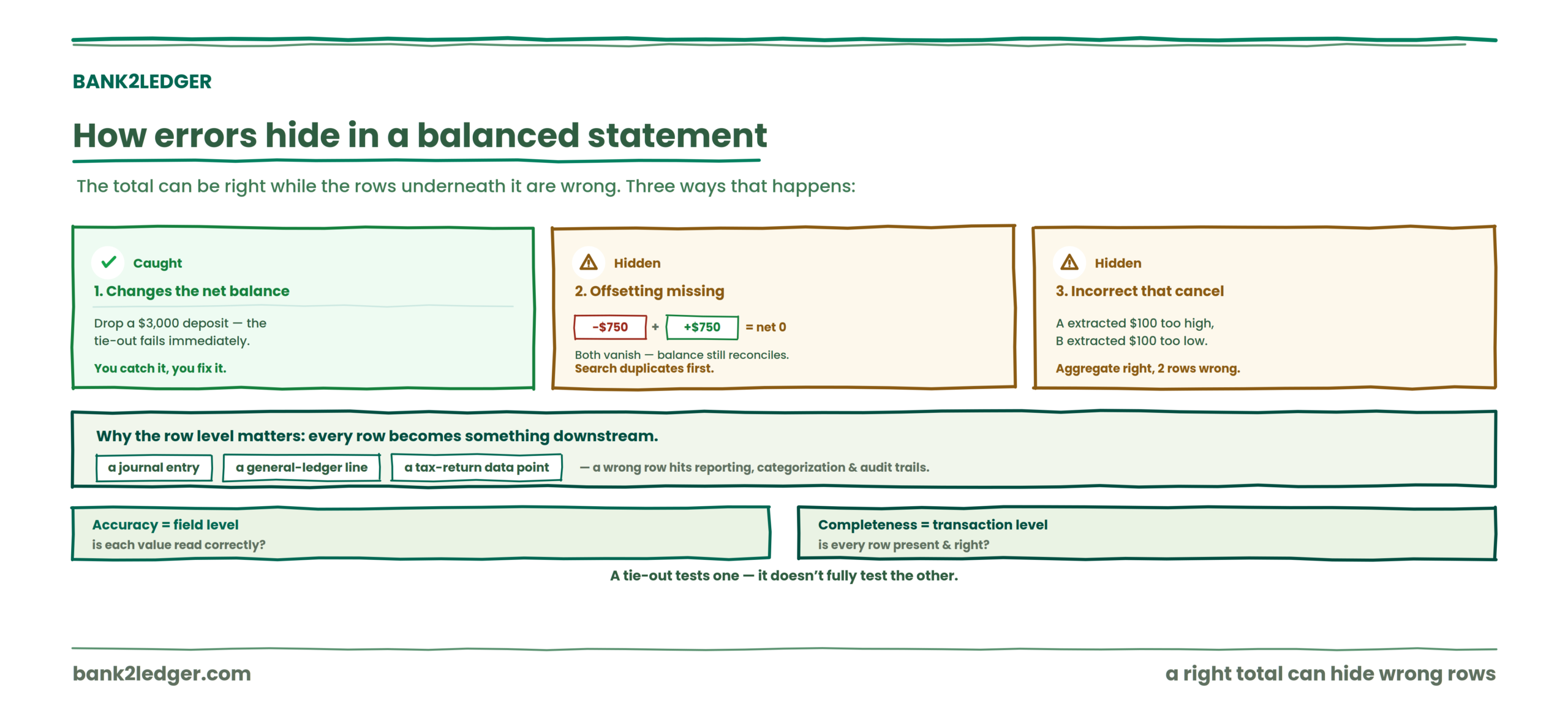
These are the easy ones. Drop a $3,000 deposit from the extracted data and the tie-out fails immediately. You catch it, you fix it.
Offsetting missing transactions
Two transactions vanish. One was a $750 debit, the other a $750 credit. Net impact: zero. The balance still reconciles. This is the scenario most people don’t think about.
Community troubleshooting forums confirm this pattern. When practitioners report that “the rec ties but something is still missing,” the root cause is often a duplicate elsewhere offsetting the omission. Search for duplicates before chasing the missing item.
Incorrect transactions that cancel each other
Transaction A extracted at $100 too high. Transaction B extracted at $100 too low. Net effect: zero. The aggregate is correct. Two individual rows are wrong.
Why this matters more at the individual-row level
Accounting data isn’t just about the total. Every row eventually becomes a journal entry, a line in a client’s general ledger, a data point in a tax return. The total can be right while the rows underneath it carry errors that affect reporting, categorization, and audit trails.
This is the distinction between bank statement extraction accuracy and data completeness. Accuracy at the field level and completeness at the transaction level are different properties. A tie-out tests one. It doesn’t fully test the other.
How accountants can check for missing transactions
Compare the statement period
Make sure the extracted data covers the same date range as the original PDF. A missing statement period between two complete statements is a workflow gap, not a ledger error, and it needs the missing statement or a reconstruction from adjacent periods.
Check the first and last transaction
If the original statement starts with a January 2 ACH debit and the extracted file starts on January 4, something was lost at the boundary.
Review page boundaries
This is where extraction problems cluster. Transactions that span pages, descriptions that wrap, layout changes mid-statement, repeated headers. If you’re going to spot-check anything, check there.
Compare running balances when available
Some statements include a running balance column. When it’s present, it gives you a row-level checkpoint that catches errors a simple aggregate tie-out misses.
Investigate any tie-out difference
If the totals don’t match, the answer is almost always in the source statement. Reset to the last reconciled closing balance and rebuild from there.
Use multiple controls instead of one
That’s the whole point. A transaction count check alongside a balance tie-out is materially stronger than either alone. Equal totals can hide offsetting errors; transaction counts expose them.
A passing balance is one control, not the whole check
Bank2Ledger checks the relationship between opening balance, activity and closing balance, flags discrepancies, and points you to the exact page to investigate, so offsetting errors don’t slip through.
Why PDF bank statement extraction makes completeness important
Page breaks can split a transaction table in ways that confuse extraction. Scanned statements introduce OCR risk where characters are misread. Multi-line descriptions complicate row detection. Different bank layouts create different extraction conditions.
None of these are reasons to distrust extraction. They’re reasons to verify it. Your existing workflow for bank statement reconciliation after PDF conversion should already account for these risks. This article is about understanding why even a passing balance check doesn’t close every one of them.
Why “the file looks right” isn’t a sufficient check
A spreadsheet can have neat columns, correctly formatted dates, plausible amounts, and a matching closing balance. It can look clean. Visual cleanliness is not the same as data completeness. The numbers might foot. The rows might not all be there.
Tie-out vs transaction-level verification
| Check | What it tells you |
|---|---|
| Opening/closing balance tie-out | Whether net movement is mathematically consistent |
| Transaction amount check | Whether individual amounts match the source |
| Date check | Whether dates were extracted correctly |
| Description check | Whether transaction descriptions were captured correctly |
| Page review | Whether all transaction sections were captured |
| Categorization review | Whether transactions map to the right client accounts |
Each row in that table answers a different question. No single row answers all of them.
Where bank statement verification fits in the accounting workflow
→
Extraction
→
Validation
→
Transaction review
→
Client-specific categorization
→
Exception review
→
Export
→
Accounting software
The tie-out lives at the validation step. It’s one control inside a larger pre-accounting workflow that moves data from bank statement to posted books. Treating it as the only control compresses eight steps into one.
Where practitioners disagree
There’s a live debate among accounting professionals about how much manual review is necessary after an automated tie-out passes. One camp argues that a passing balance check plus a transaction count comparison is sufficient for routine monthly processing. The other insists on sampling individual rows against the source PDF every time, regardless of whether the totals agree. I land closer to the second position for any statement that crossed a PDF extraction step, because the offsetting-error scenario is real even if it’s uncommon.
The ghost error table
| Symptom | Root cause | The community fix |
|---|---|---|
| Bank and books agree, but one transaction is still missing | Duplicate elsewhere offsets the omission | Search for duplicates before chasing the missing item |
| Reconciliation won’t tie even after rechecking entries | Opening balance carried forward incorrectly | Reset to the last reconciled closing balance and rebuild |
| A transaction exists but the rec screen says it’s absent | Wrong reconciliation date or period filter | Check the reconciliation date and statement ending date |
| Missing statement period between two complete statements | Statement file gap, not ledger error | Reconstruct the gap from adjacent statements and source documents |
The goal isn’t one perfect check
Extraction accuracy. Mathematical validation. Transaction-level review. Client-specific categorization. Human judgment. Stack them. No single control answers every question about the data.
+
Mathematical validation
+
Transaction-level review
+
Client-specific categorization
+
Human judgment
Verify bank statement data before it reaches the books
Bank2Ledger extracts transactions from bank statement PDFs, checks the relationship between opening balance, transaction activity and closing balance, flags discrepancies, identifies the relevant page for investigation, and supports client-specific categorization and review before export.
Frequently asked questions
Can a bank statement balance if transactions are missing?
Yes, in specific circumstances. A bank statement can balance with missing transactions when the omitted items offset each other, producing a net impact of zero on the aggregate total. A single missing transaction will almost always cause the tie-out to fail, but multiple offsetting omissions can leave the closing balance unchanged.
Does a matching closing balance prove every transaction was extracted?
No. It proves that the net movement of the extracted transactions is mathematically consistent with the statement’s opening and closing balances. Individual rows can be wrong, missing, or duplicated in ways that cancel at the aggregate level.
Can two missing transactions cancel each other out?
Yes. If one missing transaction is a debit and the other is a credit of the same amount, their combined omission has zero net effect on the balance.
What does a bank statement tie-out actually prove?
It proves mathematical consistency between the opening balance, the sum of extracted transactions, and the closing balance.
How can accountants check for missing transactions after PDF extraction?
Compare date ranges, check the first and last transactions against the source, review page boundaries, compare running balances when available, and run a transaction count check alongside the balance tie-out.
Is bank statement verification the same as bank reconciliation?
They’re related but different. Bank statement verification checks whether extracted data accurately represents the source document. Bank reconciliation compares bank records against accounting records to identify timing differences, outstanding items, and unrecorded entries. Verification happens before the data enters the books. Reconciliation happens after.